
Loading
the wiseduckdev

the wiseduckdev
Jean the Writer
AI-powered manuscript correction & editorial review tool designed to help writers prepare polished, publication-ready texts.
ROLE
- Product Manager
- Automation Engineer
- Full-Stack Developer

AI-Powered Manuscript Correction & Editorial Review Tool
At the beginning of 2025, shortly after releasing Wise Duck Dev GPTs V2, I was approached by a writer with an unusual request: could I design an AI-powered system capable of correcting his entire manuscript (600 pages, in French, without a single punctuation mark), providing structured editorial feedback, and even suggesting publishers?
What started as a client-specific challenge evolved into Jean The Writer: a powerful backend tool that automates grammar and syntax correction, delivers chapter-by-chapter editorial reviews, and compiles polished, publication-ready manuscripts.
Project Overview
Jean The Writer automates comprehensive grammar and syntax correction for manuscripts, then delivers structured editorial reviews and actionable recommendations for every chapter. By combining AI proofreading with targeted structural feedback, it transforms raw drafts into polished, publication-ready texts.
Unlike generic AI writing tools, Jean The Writer is built for long-form manuscripts. It splits texts into manageable blocks, ensures continuity, and produces clean Google Docs output with professional formatting. Writers receive not just corrections, but tailored insights that respect their style while improving clarity and flow.
- Problem solved: Saves authors weeks (or months) of manual correction and expensive editorial reviews.
- Target users: Independent writers seeking affordable, reliable, and high-quality manuscript preparation.
- Timeline: Developed in early 2025, first used on 8 manuscripts (French & Spanish).
- Differentiator: Prompt engineering and workflow automation tailored to each manuscript’s context, offering more precise, style-aware results than general-purpose tools.
My Role
This was a solo project, and I owned every part of the build, from idea to execution.
- Product Manager: Defined features directly from client needs (correction, review, suggestions, publisher search).
- Architecture & Workflows: Designed modular AI workflows inspired by my experience with Wise Duck Dev GPTs, using Chain-of-Thought style processing.
- AI Engineering: Selected the best LLMs per task. After extensive testing, OpenAI’s GPT-4o mini proved optimal for correction, review, and suggestions, balancing cost and quality. Deep Search from OpenAI was used for publisher discovery.
- Automation: Developed resume-capable logic for handling large manuscripts, ensuring the process could pick up where it left off after token/rate-limit errors.
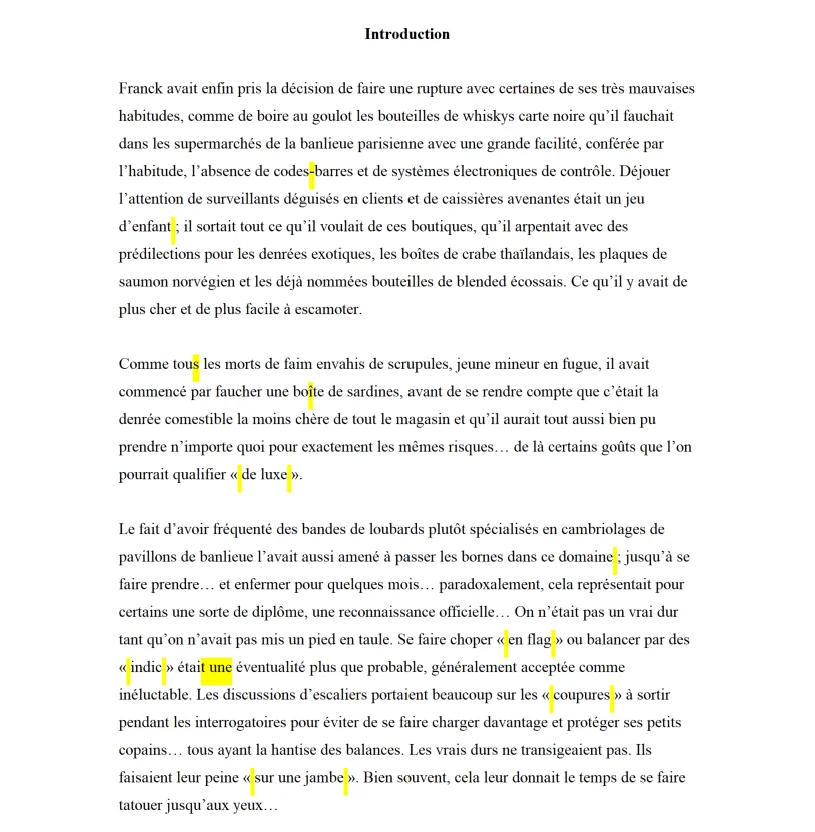
- Output UX: Choose clear Google Docs formatting (Times New Roman, 12pt, 1.5 spacing) with optional diff highlighting, chapter-level review scores, and consolidated editorial recommendations.
- Delivery: Ensured scalability so the workflow could easily be extended into a full public SaaS if needed.
Creativity & Inspiration
Unlike my other projects, Jean The Writer wasn’t born from personal observation but from a client’s unusual request. Yet it revealed an important gap: writers are underserved by AI when it comes to long-form, book-length correction and review.
This project taught me that creativity often lies in adaptation, in recognizing that a highly specific need (a punctuation-free manuscript!) can spark the creation of a tool that serves many more. It was a reminder that innovation isn’t always about ideating from scratch, but about turning challenges into repeatable, scalable solutions.
Process & Strategy
I approached the project step by step, directly aligned with the client’s needs :
- Correction : Split the manuscript into blocks, correct grammar/syntax with GPT-4o mini, output to Google Docs.
- Review : Generate per-chapter editorial reviews + suggestions with scoring.
- Recommendation : Aggregate suggestions into a final editorial review document.
- Publisher Search : Use OpenAI Deep Search to identify relevant publishers.
- Methodology: Agile, with iterative testing. Each step was validated on subsets of the manuscript before scaling to the full 600 pages.
- Testing & Feedback: The hardest part was tuning prompts to prevent AI from altering the author’s voice. Iteration was key, striking the balance between correction and stylistic respect.
- Scaling Logic: Resume scripts ensured the process could handle very large manuscripts without restarting from scratch.
Stack and Tooling
- Core: Node.js, TypeScript
- AI: OpenAI GPT-4o mini (correction, review, suggestions), OpenAI Deep Search (publisher matching)
- APIs: OpenAI API, Google Docs & Google Drive API (for output & storage)
- Automation: Custom TypeScript workflows with checkpointing (resume logic)
- Utilities: diff-match-patch (for highlighting changes), p-limit (for concurrency control)
- Dev Tools: Git, GitHub, ts-node, ESLint
Why these choices?
They were the technologies I knew best from previous projects, ensuring reliability. GPT-4o mini offered the best cost-to-quality ratio for manuscript correction at scale. Google Docs output was chosen for accessibility, since nearly every author is familiar with it.
Design and UX Highlights
Though there was no frontend, the user experience of the output was a core design focus:
- Professional Formatting : All corrected manuscripts exported in Times New Roman, 12pt, 1.5 spacing.
- Diff Highlighting : Optional side-by-side or inline highlights to visualize AI changes.
- Editorial Review : Chapter-by-chapter reviews with scores and actionable suggestions.
- Final Deliverable : Consolidated “Editorial Review Report” Google Doc with prioritized recommendations and a concluding summary.
These choices made the AI output directly usable by writers, without further formatting work.
Deployment & Scalability
Jean The Writer remains a private tool, not deployed publicly. However, the backend is designed for scalability:
- Could be extended into a SaaS with user accounts, manuscript uploads, and on-demand corrections.
- Modular architecture already supports additional languages or manuscript types.
- Pricing potential: pay-per-manuscript correction/review.
For now, it’s client-driven: writers approach me, and I run their manuscripts through the system.
Roadmap & Vision
This project was designed to solve a concrete client problem, not to evolve into a commercial SaaS. However, its potential is clear: a scalable backend that could become a platform for writers seeking affordable, professional manuscript prep.
For now, the roadmap is simple: continue refining prompts and workflows when new manuscripts arrive, adapting to each author’s style and needs.
Outcomes
- Manuscripts processed: 8 (French & Spanish).
- Unique challenge: First commission was a 600-page book written entirely without punctuation, successfully corrected and reviewed.
- Feedback:
- Corrections and publisher suggestions : highly appreciated.
- Reviews and recommendations : mixed (some authors resist stylistic changes).
The value was clear: saving weeks of manual editing and giving independent writers a professional-level editorial process at a fraction of the cost.
What I Took Away
This project reinforced and expanded my skills as both a developer and product builder.
- I learned to design AI workflows for extreme edge cases (like punctuation-free manuscripts).
- I strengthened my ability to engineer prompts at scale while respecting authorial voice.
- I deepened my OpenAI API and Google API integration skills (Docs & Drive).
- I advanced my experience in data handling and checkpointing, ensuring resilience for long-form AI processing.
- I discovered the importance of managing user psychology: authors are protective of their style, so AI must support, not overwrite, their voice.
Above all, Jean The Writer showed me that AI isn’t about replacing creativity, but about empowering it. By automating the repetitive, it gives writers more time to focus on storytelling, and that is where the real value lies.